
Ghost mannequin photography matters as this technique gives your clothes a 3D look and makes them appear “real”. This fixes the entire gap where customers hesitate to be confident. For e-commerce business owners, this is the whole game! As customers cannot feel or touch their products, photo reliability increases drastically. This is why such a photography technique is almost non-negotiable to succeed in ecommerce. The benefits and reasoning behind the use of a ghost mannequin don’t stop there; there’s more to it.
In this blog, we will break down what ghost mannequin photography actually is and why it matters so much in apparel e-commerce. We would also explore the real costs and issues so you can jump in without guessing.
Table of Contents
ToggleWhat Is Ghost Mannequin Photography?
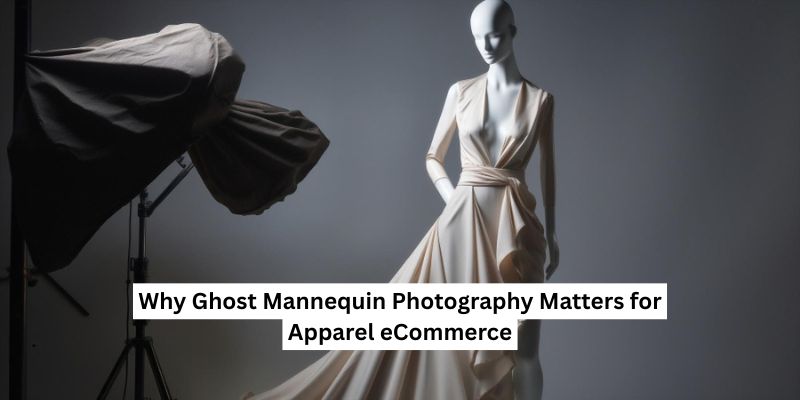
Ghost mannequin photography is when a product is photographed on a mannequin first, and then edited out so the clothing appears to be worn by an invisible ghost mannequin with a clean 3D shape.
What you get from this type of photography is:
- The cloth has real volume, structured shoulders, sleeves that hold their shape, and a torso with depth.
- The inside of the key area is usually visible, so it does not appear to be a flat cutout.
- It looks on-body but without showing a model or a mannequin.
How is it done?
Ghost mannequin photography is usually simple to do with just a few steps:
➣ First, style the garment on a mannequin. Smooth it, clip or pin it for symmetry, and align the seams and hem.
➣ Then you need to shoot the main image, usually in the front and sometimes the back
+ side + detail shots.
➣ Shoot an insert image. After you are done with the initial photography, remove the mannequin’s neck piece or reposition the garment, then shoot the inside label or the neck area. This insert creates the clean “hollow” 3D neckline.
➣ Now it’s time for editing and compositing in post-production. Here, you ask the mannequin, combine the main shot and insert shot, clean up wrinkles, dust, and stray threads, colour-correct it so the cloth matches the real product, and export for web or marketplace specs.
You need to remember what a ghost mannequin is not to get the best shot. Here’s what it is not:
- Ghost mannequin is not a 3D render or CGI.
- Not just a “cutting out” or a flat lay.
- Not automatically “better” than models; rather, it’s built for clarity and consistency, not lifestyle storytelling.
Why Ghost Mannequin Photography Is Important for Apparel eCommerce?
Online apparel is all about trust. Customers can’t touch the fabric, try it on, or even get a proper look at the quality in real life. So they rely solely on the photography of your store, and it does all the heavy lifting. Among all types of apparel photography, ghost mannequin photography stands out most for its realistic feel, structured look, and other benefits. Here’s why this photography is so popular among e-commerce owners:
Creates a Realistic 3D Look
Flat product photos can make your clothing look unrealistic. But a ghost mannequin fixes that by showing the shape of your clothes on a real body. The 3D realistic look of the cloth matters because it communicates:
- Structure of the shoulders, sleeves, and torso volume.
- Shows how the fabric drapes rather than collapsing like a pancake.
- Construction cues like seams, panels, collars, and cuffs look intentional, not just accidental.
- The neckline or collar depth makes it look like a real garment rather than a cutout.
When shopping for apparel, buyers don’t just buy a piece of clothing that looks nice; they want something that looks nice on them. A ghost mannequin gives clothes a better fit than a flat lay ever will.
Improves Product Presentation
An e-commerce apparel business is not about just making your clothes look pretty. It’s about making your store easier to browse and easier to trust. Ghost mannequin photography improves the presentation in three practical ways:
- Your cloth catalogs look consistent. When you get photos from the same angle, with the same framing and lighting, products look like they belong to the same brand.
- Your products look more premium. Even if your pricing is mid-range, clean, structured imagery makes it look premium. People judge quality visually in e-commerce businesses.
- The product becomes the focus. Models can be powerful, but they can also be distracting. While ghost mannequin photography is clean, it keeps attention focused on the silhouette, details, textures, and fit-related cues.
If your goal is clear selling, then ghost mannequin is one of the most quietly effective methods you can use.
Builds Trust and Reduces Returns
Returns in apparel usually happen because buyers do not see the final product match the picture they saw. After delivery complains appear like:
- “It looked thicker online.”
- “The fit looked different.”
- “The neckline/length/shape surprised me.”
- “The quality looked better in photos.”
Ghost mannequin photography does not magically eliminate all complaints or return issues; it reduces the most common triggers that can cause expectation mismatches. This photography method builds trust by providing:
✔ More accurate shape and fewer surprises about the fit and silhouette.
✔ Clear details, which means there will be fewer quality issues.
✔ Consistent presentation of your product, so your store feels legit and not just thrown together.
If your photos are unclear, customers do not just return the products more; they also hesitate to click the buy button in the first place. The Ghost mannequin photography method improves both sides. So your customers are more confident before purchasing and have fewer complaints about not meeting the expectation after delivery.
Works Perfectly for All Clothing Categories
A ghost mannequin is flexible because it is not tied to a single clothing style. You can present any style and cloth on it, as it is a presentation format. It works across every apparel category where shape matters. However, such a photography method shines the most on:
- Tops where the neckline, shoulder line, and sleeve shape look clean and consistent.
- Outwear looks great because customers can see its structure and thickness more clearly in 3D.
- Dresses and one-piece garments stand out because their silhouettes look real, not like fabric blobs.
- In Activewear, fit lines, panels, and cuts are clearly
- As for uniforms, customers can see a clean, distraction-free presentation.
If you are selling apparel that is highly body-dependent, then you must use Ghost mannequin photography to avoid any issues.
Note: Learn more about "How Ghost Mannequin Editing Boosts Apparel eCommerce Presentation"
Benefits of Ghost Mannequin Photography for Ecommerce Store Owners
Ghost Mannequin photography pays off because it makes your products easier to judge and your catalogues easier to scale. Apart from that, you can unlock several benefits from the photography technique. Here are some of the exclusive benefits that Ghost mannequin photography provides for ecommerce store owners:
Higher Conversion Rates
Shoppers don’t usually read every product description; they first look at the page and try to visually confirm what they are about to buy. Baymard’s usability testing revealed that 56% of users’ first action on a product page is exploring product images.
Ghost mannequin photography helps conversion because it reduces two of the biggest apparel conversion killers: uncertainty and perceived risk. That clean 3D shape makes the garment feel more real than any flat images, which makes the decision easier.
So how do you know it’s actually working?
- Track the add-to-cart and conversion rates for products as you have switched to ghost mannequin photography.
- Watch product pages’ bounce rates.
- Compare the reasons for returning before and after.
It’s not a magical remedy; instead, it provides clear visuals and better attention to detail that actually work for ecommerce conversions.
Better Visual Consistency
Consistency is not just an aesthetic preference, but it’s a trust signal. When every product on your product page follows the same rules, your collection pages become easier to scan, and your store feels intentional. It doesn’t feel like a bunch of random supplier pics stitched together, so your store appears more professional.
The ghost mannequin is one of the easiest formats to standardise because it is built for repeatability and consistency. Visual consistency matters so much in ecommerce because:
- Your category page looks cleaner, so customers can browse longer.
- The products look like they are from the same brand.
- It becomes easier for shoppers to compare items quickly.
Also, Pro Tip: make sure you take the photos at the same height, distance, and focal length. Keep the background the same and include standard editing to get perfectly consistent photos.
Faster Browsing experience for customers
Browning experience is not just about site speed; it’s also about decision speed. Ghost mannequin photos make browsing faster because:
- Every thumbnail is readable at a glance.
- Customers are not decoding weird angles or inconsistent framing.
- Your grid becomes a clean comparison tool instead of a chaotic collage.
There’s also the technical side: if your images are large and unoptimized, your pages load more slowly (especially on mobile), which disrupts the browsing flow. For example, Shopify supports large images and automatically serves them in supported formats via its imagery system, but you still need to upload smart files so your pages don’t get heavy.
When people can browse quickly, they see more products, compare more options, and buy sooner. That’s the real win.
Stronger Brand Identity
Your brand identity isn’t just your logo. It’s the feeling your store gives off in 3 seconds. Ghost mannequin photography builds brand identity because it creates a consistent visual language:
- Clean, minimal, product-first.
- “We care about details”.
- Professional, not dropship-y.
- Catalogue-like consistency.
As the mannequin disappears, your product becomes the focal point; not the model, not the styling, not the background distractions.
The honest take:
Ghost mannequin is perfect for your core catalogue images. But if your brand sells lifestyle, status, or “wear this to become this person,” you’ll still want model/lifestyle images too. Ghost mannequin sets clarity while lifestyle sells the story.
Marketplace Compliance
Marketplaces don’t care about your creative direction. They care about the rules.
Ghost mannequin photography is naturally compliant-friendly as it keeps the product image clean and consistent. But you still need to follow each platform’s photo policies, or you’ll face rejections, suppressed listings, or reduced visibility.
Here are a few popular platform rules to keep in mind:
Amazon
Amazon’s main image rules are strict. The Seller Central image guide explicitly calls out requirements like:
- The product should fill about 85% of the image
- No text, logos, borders, color blocks, or watermarks
- Show the entire product
- The main image is typically on a white background
Ghost mannequin photography works well here because it presents the garment cleanly without extra props or distractions.
eBay
eBay’s picture policy is also clear about what not to do:
- No added text or marketing material
- No borders
- No watermarks of any type
- Photos must be at least 500 px on the longest side
Shopify
Shopify isn’t “compliance strict” like a marketplace, but it has technical rules that affect performance and image quality:
- Product/collection images can be up to 5000 × 5000 px (or 25 MP)
- File size must be under 20 MB to upload
- Plus, adding alt text matters for accessibility and can support SEO.
So the bottom line is that Ghost mannequin photography makes it easier to produce images that meet platform rules without constantly reworking your visuals. Less back-and-forth, fewer listing issues, and smoother scaling
Best Product Photography Type: Ghost Mannequin vs. Flat Lay
Many ecommerce owners prefer flat lay photographs over ghost mannequin photography. But which one is actually best for apparel ecommerce? You can only confirm this with a Ghost Mannequin vs. Flat Lay comparison. Here’s the real difference that sets them apart:
| Decision factor | Ghost Mannequin | Flat Lay |
|---|---|---|
What it is | Garment on mannequin, mannequin removed in edit | Garment laid flat, shot from above |
Primary job | PDP hero that sells fit and structure | Editorial/layout that sells styling and vibe |
Depth / 3D feel | Strong on-body volume | Mostly 2D (can look flat) |
Fit + silhouette clarity | High (shape reads fast) | Medium–low (shape depends on styling skill) |
Drape communication | Good (fabric hangs on a form) | Good for fabric spread, weaker for “hang.” |
Neckline/collar depth | Strong; insert/composite makes it feel real | Usually weak and often looks like a cutout |
Texture + patterns | Good | Great, the surface details can pop |
Size/scale context | Medium (looks worn, but no real body) | Low (needs extra shots for scale) |
Consistency across SKUs | High; easy to standardize angles/crops | Variable, styling, and wrinkles change output |
Best for catalog browsing | Strong, clean thumbnails, fast comparison | Mixed; great when consistent; messy if not |
Creative flexibility | Low–medium (minimal, product-first) | High (props, bundles, story, seasonal sets) |
Setup needed | Mannequin, controlled lighting & styling tools | Flat surface, overhead rig/tripod & styling tools |
Styling effort | Moderate, need pin/clip for symmetry & fit | Low for basics; high for “perfect” layouts |
Post-production | Heavier, need masking, compositing + and cleanup | Lighter; just need cleanup, color, and background correction |
Typical cost drivers | Editing time + skilled retouching | Styling time + reshoots for wrinkles/alignment |
Scaling to high SKU volume | Great when templated + outsourced editing | Great for simple items; harder when sets vary |
Marketplace hero image safety | Usually safer (clean, product-only look) | Safe only if minimal; props/text break rules |
Where it shines in a gallery | Front, back images, and detail shots | Secondary angles, bundles, “what’s included,” social |
Why Fashion Brands Rely on Ghost Mannequin Photography
Fashion brands love Ghost mannequin photography for its versatility. It’s not just about the clear aesthetic it serves; it’s also about the impact it has on shoppers. Here’s why most fashion brands heavily rely on ghost mannequin photography for their apparel:
- Fit clarity without the noise: Ghost mannequin gives that worn, 3D shape, so the shoulders, sleeves, drape, and neckline depth can be visible without a model. Also, the attention remains centered. For ecommerce, that’s a win because the shopper is trying to judge the garment, not the shoot’s vibe.
- Catalog-level consistency: Fashion brands live and die by how their category pages look. Ghost mannequin photography makes it easier to maintain consistent framing, angles, lighting, and spacing across hundreds of products. The result is a storefront that looks intentional and premium, not like a bunch of random shoots stitched together.
- Faster production for big drops: When you’re launching weekly or running multiple color variants, model shoots get complicated fast. You get caught up with casting, schedules, reshoots, changes in hair/makeup, or inconsistent posing. The ghost mannequin is repeatable. You can build a process and run it like a production line.
- Cost control that still looks premium: Flat lay can be cheaper, models can be expensive, and both can be inconsistent if you’re moving fast. But the Ghost mannequin sits in a sweet spot: it looks polished and high-end, but the cost stays manageable because the setup is controlled and the output is standardized.
- Editing services do most of the work: Shooting is only half of it for ghost mannequin photography. A major part of this is done in post-production. This is exactly why fashion brands heavily rely on ghost mannequin editing services. These brands can outsource the work and focus on other shooting and product improvements, which are crucial to scaling these businesses.
Note: Read more to learn about "How to Choose the Right Ghost Mannequin Editing Company"
Frequently Asked Questions (FAQs)
What is the invisible ghost mannequin effect?
It means that a garment is photographed on a mannequin, and then the mannequin is removed in editing so the clothing looks as if it’s being worn by an invisible body with a clean 3D shape.
How much does ghost mannequin editing cost?
It typically ranges from about $0.89/image (high-volume service pricing) to $5+ per image on freelance marketplaces, depending on complexity, turnaround, and how clean your raw photos are.
Final Verdict
Ghost mannequin photography has been in the ecommerce field for ages. It’s not just a marketing gimmick brands are using; this technique has a real impact. This photography method is about using a 3D model and then removing it in post-production so it looks like an invisible model is wearing the fabric.
This method looks super cool, yes, but it also provides clarity, improved brand value, greater trust, consistency, and a single model that fits all. Not just that, you will all be set to reap benefits like higher conversion rates, lower return rates, better marketplace compliance, and more. Although many prefer flat-lay product photos, you can see why they’re better with the comprehensive comparison in this blog. Also, ghost mannequin photography is popular among fashion brands for several reasons. All these you can explore in this blog and get a heads up on what actually is going to work for your apparel ecommerce brand.