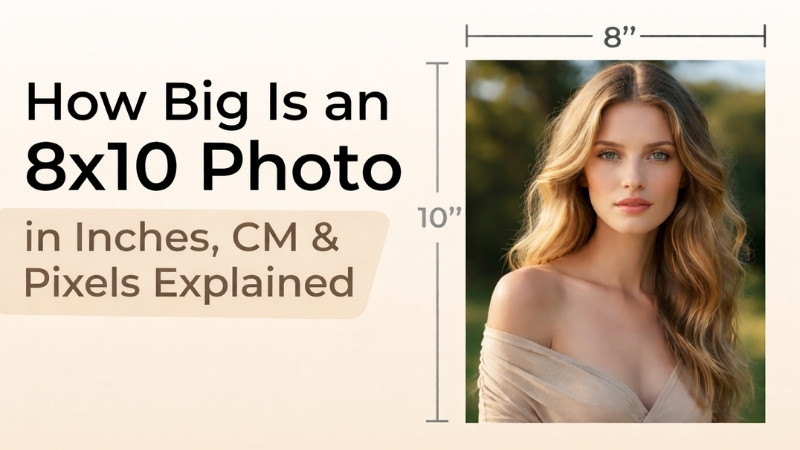
“How Big Is an 8×10 Photo?” sounds like a quick question until you actually try to print one.
Suddenly, your image gets cropped. Faces feel tighter than expected. Or the print looks slightly different from what you saw on your screen. That’s because 8×10 doesn’t behave the same way as the photos we usually take on phones.
Most people only realize this after printing.
This guide is here to fix that. You’ll understand exactly how big an 8×10 photo is in inches, centimeters, and pixels, but more importantly, you’ll learn how it affects your image before you hit print.
Table of Contents
ToggleHow Big is an 8x10 Photo?
An 8×10 photo measures exactly 8 inches by 10 inches (20.3 cm × 25.4 cm).
That’s the simple answer, but to actually use this size correctly, you need to understand what those numbers mean in practice.
An 8×10 is considered a medium-to-large print size. It’s big enough to display clearly on a wall, desk, or in a frame without requiring people to step closer to see the details. At the same time, it’s not oversized, which makes it one of the most commonly used formats for portraits, school photos, and professional prints.
What makes 8×10 different from many other photo sizes is its aspect ratio. An 8×10 has a 4:5 ratio, while most phone cameras and digital images are shot in 3:2 or 4:3. Because of this difference, your image often needs to be cropped slightly to fit perfectly into an 8×10 frame.
This is where most people run into issues. A photo that looks perfectly framed on your phone might have its edges cut off or feel tighter when printed as an 8×10. Faces can appear closer, and the background elements may get trimmed out.
In short, while the physical size is fixed and straightforward, the way your photo fits into that space depends on how it was originally captured. Understanding this early helps you adjust your composition before printing, rather than fixing problems afterward.
How Big is an 8x10 Photo in Inches?
An 8×10 photo is exactly 8 inches wide and 10 inches tall.
That means if you’re holding the photo in portrait orientation, the height is longer than the width, which is why this size works especially well for portraits, headshots, and vertical compositions.
In landscape orientation, those dimensions flip (10 inches wide and 8 inches tall), making it suitable for group photos or wider scenes. But regardless of orientation, the total size stays the same; it’s always an 8-by-10-inch print.
To give you a clearer sense of scale, an 8×10 is slightly larger than a standard sheet of paper folded in half, and noticeably bigger than common photo sizes like 4×6 or 5×7. It’s large enough to show facial details clearly without zooming in, which is why it’s often used for framing and display.
The key thing to remember here is that while the size in inches is fixed and simple, how your image fits within those 8×10 boundaries depends on its original proportions, something we’ll break down further as we go.
How Big Is an 8x10 Photo in Centimeters & Millimeters?
An 8×10 photo measures 20.3 × 25.4 centimeters, or 203 × 254 millimeters.
Using standard unit conversions, 8 inches and 10 inches yield precise metric dimensions, not estimates.
This is especially useful if you’re ordering prints, frames, or albums from regions that use the metric system. Many print labs and frame manufacturers list sizes in centimeters or millimeters, so knowing the exact equivalent helps you avoid mismatches.
In terms of real-world size, 20.3 × 25.4 cm is still considered a medium-to-large print. It’s large enough for clear visibility on a wall or tabletop frame, but compact enough to fit into standard photo frames without custom sizing.
The important thing to keep in mind is that while the unit changes, the proportions stay the same. Whether you’re working in inches, centimeters, or millimeters, the shape of the photo doesn’t change, so cropping and composition rules still apply in exactly the same way.
How Big Is an 8x10 Photo in Pixels?
An 8×10 photo is typically 2400 × 3000 pixels for high-quality printing at 300 DPI.
In the standard print rule, 300 pixels per inch (PPI) is considered the ideal resolution for sharp, professional-quality prints. When you multiply 8 inches by 300 pixels per inch and 10 inches by 300 pixels per inch, you get 2400 × 3000 pixels.
But it’s important to understand that pixels are not fixed like inches or centimeters. The pixel size of an 8×10 depends on the resolution you choose:
- At 300 PPI (print quality) → 2400 × 3000 pixels
- At 150 PPI (lower quality print) → 1200 × 1500 pixels
- At 72 PPI (web use) → 576 × 720 pixels
Higher pixel counts mean more detail and sharper prints, especially when viewed up close. Lower pixel counts may still look fine on screens, but can appear soft or pixelated when printed.
So while “8×10” defines the physical size, pixels define how clear and detailed your photo will look at that size. That’s why understanding both together is key before printing or resizing your images.
How Big is an 8x10 Photo Size in Pixels for Printing and Web?
An 8×10 photo doesn’t have one fixed pixel size; it depends on whether you’re using it for printing or for screens.
The physical size remains 8×10 inches, but the pixel dimensions vary with resolution (PPI). For printing, you need a higher pixel density for sharp detail. For web use, a lower pixel density is enough because screens don’t display the same level of detail as print, so when it comes to printing, you need a different density.
For Web
For screens, an 8×10 photo is usually around 576 × 720 pixels at 72 PPI.
This lower resolution works because digital displays don’t require as many pixels to look clear. Using smaller pixel sizes also helps reduce file size, which improves loading speed on websites and social platforms.
That said, many modern screens (especially high-resolution displays) can benefit from slightly larger images. So in practice, people often use higher pixel dimensions than 72 PPI to keep images looking crisp across devices.
The key point is that, for web use, you’re balancing clarity and file size, not aiming for maximum detail.
For Printing
For high-quality printing, an 8×10 photo should be 2400 × 3000 pixels at 300 PPI.
This is the industry standard because it produces sharp, detailed prints, even when viewed up close. At this resolution, fine details like skin texture, hair, and edges remain clear rather than soft or pixelated.
If you go lower, for example, 150 PPI (1200 × 1500 pixels), the print may still look acceptable from a distance, but it won’t have the same level of sharpness.
The key point is that, for printing, resolution directly affects quality, so higher pixel dimensions are essential.
What Is the Aspect Ratio of an 8x10 Photo?
An 8×10 photo has a 4:5 aspect ratio.
That simply means the width and height are in a proportional relationship: for every 4 units of width, there are 5 units of height. This shape is fixed and defines how your image fits into an 8×10 frame.
The important part is how this compares with most of the photos you already have.
- Many DSLR and mirrorless cameras shoot in 3:2
- Most smartphones use 4:3 by default
Since neither of these matches 4:5 exactly, your image usually needs to be cropped to fit into an 8×10.
In practical terms, cropping often occurs along the longer edges. For example, a 3:2 image will lose some width, while a 4:3 image may lose a bit from the top and bottom. That’s why photos can feel slightly tighter or more zoomed in after printing at 8×10.
This isn’t a flaw; it’s just how proportions work. The key is to leave a bit of extra space around your subject when shooting, especially near the edges. That way, when the image is adjusted to a 4:5 ratio, nothing important gets cut off.
Once you understand this, working with 8×10 becomes predictable instead of frustrating.
Standard 8x10 Photo Frame Size
A standard 8×10 photo frame is designed to fit a print that measures exactly 8 × 10 inches.
That means if your photo is properly sized to 8×10, it will fit directly into any standard 8×10 frame without resizing or adjustment. When implementing, you’ll come across two common types of frames:
- Exact-fit frames: These hold the full 8×10 photo edge-to-edge. What you print is exactly what you see in the frame.
- Matted frames: These are larger frames (often 11×14) that include a mat with an opening for an 8×10 photo. The mat creates a border around the image, which helps draw attention inward and gives the photo a more finished, gallery-style look.
One detail people often overlook is that mat openings are sometimes slightly smaller than 8×10 (by a few millimeters). This is intentional; it keeps the photo secure and prevents edges from showing unevenly.
The summary is simple: as long as your print is a true 8×10, it will work with standard frames. The only decision you need to make is whether you want a clean edge-to-edge display or a framed look with a mat for added visual depth.
8x10 Photo Size & Other Standard Photo Sizes Comparison Chart
Before choosing an 8×10, it helps to see how it compares to other common photo sizes. Not just in terms of inches, but in how they feel when printed, how much detail they show, how they fit in frames, and whether they require cropping. Each size serves a slightly different purpose. Understanding these differences makes it easier to pick the right size instead of adjusting after printing.
8x10 vs 4x6 Photo
A 4×6 photo (4 × 6 inches) is much smaller and follows a 3:2 aspect ratio, which matches most cameras and smartphones. This means photos usually print on 4×6 without any cropping.
In comparison, an 8×10 is larger and uses a 4:5 ratio, so it often requires trimming parts of the image.
What this means in use:
- 4×6 is better for quick prints, albums, and everyday use
- 8×10 is better for framing and display, where size and presence matter more
If you want convenience, 4×6 works. If you want impact, 8×10 stands out more.
8x10 vs 5x7 Photo
A 5×7 photo sits between 4×6 and 8×10 in both size and proportion. It uses a 5:7 aspect ratio, which is closer to 4:5 than 3:2, so it usually requires less cropping than an 8×10.
Compared to 5×7, an 8×10 is noticeably larger and gives more room for detail, especially in portraits.
What this means in use:
- 5×7 is a balanced option for small frames and gifts
- 8×10 is better when you want the photo to feel more prominent on a wall or desk
8x10 vs 11x14 Photo
An 11×14 photo (11 × 14 inches) is larger than an 8×10 and has a different aspect ratio (roughly 4:5, though not exact). Because of the size increase, it shows more detail and works better for larger wall displays.
However, it also requires more space and higher-resolution images to maintain sharpness.
What this means in use:
- 8×10 is easier to frame and fits most spaces
- 11×14 is better for statement pieces where you want the image to stand out more
8x10 vs 16x20 Photo
A 16×20 photo (16 × 20 inches) shares the same 4:5 aspect ratio as an 8×10, just at a larger scale. This means you can enlarge an 8×10 image to 16×20 without changing its shape or cropping further.
The main difference is size and viewing distance.
What this means in use:
- 8×10 works well for close viewing desks, shelves, and small walls
- 16×20 is designed for larger walls where the image needs to be seen from a distance
Because of the size, 16×20 also requires a higher-resolution image to avoid losing detail when printed.
Best Uses for 8x10 Photo Prints
An 8×10 photo size is practically a sweet spot. Because of this balance, it’s widely used across different types of photography, especially where clarity and presentation both matter. Here are some of the best uses:
Portrait photography
Portrait photography focuses on capturing a person’s expression, personality, and presence, usually with attention to face, posture, and lighting. This is where 8×10 works particularly well.
The size provides enough space to show facial detail without feeling oversized, making it ideal for framing or keeping as a keepsake. Because of the 4:5 aspect ratio, portraits often feel more natural and balanced in this format compared to wider sizes.
When it works best:
- Solo portraits and close-up shots
- Studio sessions or controlled lighting setups
- Images where facial expression is the main focus
Wedding & event photos
For weddings and events, 8×10 is often used for highlight moments rather than bulk printing. It’s a size that works well for displaying key images like couple portraits, family group shots, or important candid moments.
Because it’s larger than standard prints, it gives those selected photos more presence without needing a large wall space.
When it works best:
- Framing a few important shots from the event
- Creating small display areas at home
- Including in albums as featured images
School & Graduation Photos
8×10 is one of the most commonly used sizes for school portraits and graduation photos. It provides enough detail for faces, outfits, and small elements like certificates or caps without feeling cramped.
Many schools and studios offer 8×10 as a standard print option because it fits easily into common frames and display spaces.
When it works best:
- Individual student portraits
- Graduation milestones
- Photos meant for long-term display
Home Wall Decor & Gallery Walls
An 8×10 works well both on its own and as part of a larger gallery wall. It’s big enough to stand alone in smaller spaces, but also flexible enough to combine with other sizes.
Because it’s not too large, you can arrange multiple 8×10 prints without overwhelming the wall.
When it works best:
- Mixed-size gallery walls
- Hallways, bedrooms, or small living areas
- Creating a balanced layout with other frame sizes
Professional Headshots
A headshot is a specific type of portrait focused on the face, typically used for professional purposes such as resumes, profiles, or branding. The 8×10 size works well for printing headshots because it keeps the focus tight and clear.
When preparing a headshot photography for print, a few key points matter:
- Keep the composition centered and not too tight to avoid cropping issues
- Use even lighting to avoid harsh shadows on the face
- Maintain high resolution so details remain sharp in print
These small adjustments are often covered in detailed headshot photography tips to make a noticeable difference when moving from digital to print.
Gift Ideas
An 8×10 photo makes a practical and meaningful gift because it’s ready to frame and display without needing special sizing.
It’s large enough to feel personal and intentional, but still easy to handle and package. Whether it’s a family photo, a memory from an event, or a portrait, the size works well for gifting without requiring customization.
When it works best:
- Framed photos for birthdays or celebrations
- Memory-based gifts (family, friends, milestones)
- Prints that are meant to be displayed immediately
What Resolution Is Best for Printing an 8x10 Photo?
The best resolution for printing an 8×10 photo is 300 PPI (pixels per inch), which equals 2400 × 3000 pixels.
This is the standard used by professional labs because it produces sharp, detailed prints, even when viewed up close. At this resolution, fine details like facial features, textures, and edges remain clear rather than soft.
You can print at lower resolutions, but the quality will drop:
- 150 PPI (1200 × 1500 pixels): acceptable for casual prints or viewing from a distance
- Below 150 PPI: noticeable loss of sharpness and detail
So, if you want your 8×10 to look clean and professional, aim for 300 PPI whenever possible.
Frequently Asked Questions (FAQs)
Is 8x10 a standard photo size?
Yes, 8×10 is a standard photo size widely used for portraits, frames, and professional prints.
What resolution do I need for an 8x10 print?
For best quality, use 300 PPI, which equals 2400 × 3000 pixels.
How big is an 8x10 photo frame?
A standard 8×10 frame fits a photo that is exactly 8 × 10 inches, though matted frames may be larger.
Can I print an 8x10 Photo from my phone?
Yes, as long as your photo has enough resolution (ideally close to 2400 × 3000 pixels), you can print it clearly.
Final Verdict
Understanding how big an 8×10 photo is goes beyond just knowing the numbers. Once you’re clear on its size in inches, centimeters, and pixels, you start to see how it behaves, how it fits within frames, how it affects composition, and why cropping is necessary for most photos. These small details are what separate a print that looks “fine” from one that feels properly framed and intentional.
In use, 8×10 remains one of the most reliable and versatile photo sizes. It’s large enough for display, structured enough for portraits, and widely supported by frames and print labs. As long as you pay attention to resolution and aspect ratio before printing, you can use this size confidently without running into unexpected results later.


