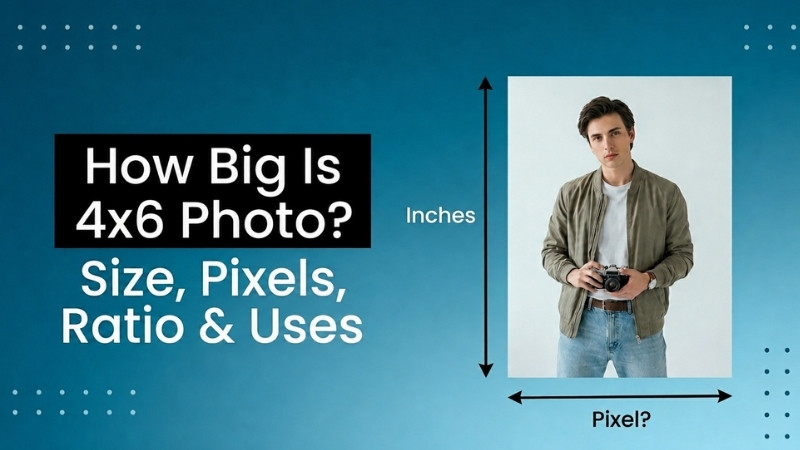

A 4×6 photo measures exactly 4 inches by 6 inches (10.16 × 15.24 cm, or 101.6 × 152.4 mm). At 300 DPI, the standard for high-quality printing, it requires 1200 × 1800 pixels.
A 4×6-sized photo uses a 3:2 aspect ratio, which matches most DSLR cameras and traditional 35mm film. You must understand its measurement, usage, and pixel count before using it everywhere.
If you just need the exact size details quickly, here’s everything in one place:
| Measurement Type | 4×6 Photo Size |
|---|---|
Inches | 4×6 inches |
Centimeters | 10.16×15.24 cm |
Millimeters | 101.6×152.4 mm |
Pixels (300 DPI) | 1200×1800 px |
Pixels (150 DPI) | 600×900 px |
Aspect Ratio | 3:2 |
This is the standard size used for most photo prints, albums, and everyday photography. It’s small enough to hold comfortably but large enough to clearly display people, places, and details.
Table of Contents
ToggleWhat is a 4x6 Photo?
A 4×6 photo is a standard print size, measuring 4 inches by 6 inches. In metric units, it equals 10.16 × 15.24 cm or 101.6 × 152.4 mm.
It uses a 3:2 aspect ratio, which matches the native format of traditional 35mm film and most DSLR cameras. Because of this, 4×6 photos can usually be printed without heavy cropping.
A standard 4×6 photo size in pixels at 300 DPI is: 1200 × 1800 pixels
The 4×6 format is the most commonly used photo size for:
- family pictures
- photo albums
- postcards
- greeting cards
- tabletop frames
- everyday photo printing
It is considered the standard photo size because it hits a balance among image detail, affordability, and ease of storage. Most photo labs, printers, and frames are designed to support 4×6 prints by default.
How Big a 4×6 Photo Looks in Real Life?
A 4×6 photo is about the size of a typical postcard. If you hold it in your hand, it comfortably fits within your palm without feeling too small.
To visualize it better:
- It’s slightly larger than a credit card
- Smaller than a standard A5 notebook
- Roughly the size used in most printed photo albums
In practical terms, 4×6 is the “default photo size” most people think of when printing pictures. It’s large enough to capture meaningful detail but compact enough to store, frame, or share easily.
How Big is a 4×6 Photo in Every Unit
Understanding the size across different units helps you determine the correct measurement, whether you’re printing, designing, or resizing images.
4×6 Photo Size in Inches
A 4×6 photo is exactly:
- 4 inches wide
- 6 inches tall
This is the original measurement format and the standard used in printing labs worldwide.
4×6 Photo Size in CM (Centimeters)
In metric units, a 4×6 photo measures:
- 10.16 cm × 15.24 cm
This is useful if you’re ordering prints internationally or using design tools set to metric units.
4×6 Photo Size in MM (Millimeters)
For more precise measurements:
- 101.6 mm × 152.4 mm
This level of precision matters in professional printing, framing, and layout alignment.
4×6 Photo Size in Pixels (At Different DPI)
Pixel dimensions depend on the print resolution or DPI (dots per inch). Here’s what a 4×6 photo size looks like in different resolutions:
| DPI (Print Quality) | Pixel Dimensions | Quality Level |
|---|---|---|
300 DPI | 1200×1800 px | High quality (best for printing) |
200 DPI | 800×1200 px | Good (acceptable for most prints) |
150 DPI | 600×900 px | Low (may lose sharpness) |
72 DPI | 288×432 px | Screen only (not suitable for print) |
If you’re printing photos, 300 DPI is the gold standard. Anything below 150 DPI will start to look blurry or pixelated, especially when viewed up close.
The 4×6 Aspect Ratio: What Is 3:2 and Why Does It Matter?
A 4×6 photo uses a 3:2 aspect ratio, which simply means the width and height are proportional, 6 units long for every 4 units wide. The 3:2 aspect ratio matters to avoid cropping issues, better composition, and better printing.
This ratio isn’t random. It comes from 35mm film, which set the standard for modern photography. Most DSLR and mirrorless cameras still shoot in 3:2 because it creates a natural, balanced composition that feels visually pleasing.
Why this matters in real life:
- No cropping for camera photos: Images taken on DSLRs fit perfectly into a 4×6 print
- Better composition: The frame naturally suits landscapes, portraits, and everyday shots
- Consistent printing: Labs are optimized for this exact ratio
If your image doesn’t match 3:2, something will get cropped when printing. That’s where most problems begin.
What Happens If the Aspect Ratio Doesn’t Match?
If your image uses a different aspect ratio, such as 4:3, 1:1, or 16:9, the print lab must either:
- Crop part of the image, or
- Add white borders to make it fit
For example:
- Instagram square photos (1:1) lose portions of the top and bottom
- Widescreen photos (16:9) often get trimmed at the sides
- Smartphone photos (commonly 4:3) usually crop slightly when printed as 4×6
This is why understanding aspect ratio is essential before printing photos.
Why 4x6 Is the Standard Photo Size?
A 4×6 photo is considered the standard photo size because it matches the native 3:2 aspect ratio used by traditional 35mm film and most modern DSLR cameras. Since images are naturally captured at this aspect ratio, they can be printed as 4×6 photos with little to no cropping, making the format practical, cost-effective, and widely compatible.
The popularity of 4×6 prints began during the rise of film photography. Photo labs needed a print size that preserved the original composition of 35mm negatives, and the 4×6 format became the perfect solution. Over time, camera manufacturers, photo printing companies, and frame makers standardized on this size, making it the default format for everyday photography.
Today, whenever you search for:
- standard photo size
- regular picture size
- default print size
- most common photo print size
The answer is mostly a 4×6 photo.
The reason 4×6 remains the industry standard is its balance between size and usability. It’s:
- large enough to display clear detail
- compact enough for albums and storage
- inexpensive to print
- compatible with most photo frames and printers
This versatility makes 4×6 ideal for family photos, travel pictures, postcards, greeting cards, school photos, and everyday printing.
Even in this smartphone era, most online photo labs and retail printing services still use 4×6 as their default print option because it remains the most practical and universally supported photo size.
Where 4×6 Photos are Commonly Used?
The 4×6 size is incredibly versatile, which is why it’s used across personal, creative, and professional settings.
Personal & Everyday Uses
This is where 4×6 photos are most common. You can see them on all sorts of products, like:
- Photo albums and scrapbooks
- Family memories and travel photos
- Desk frames and bedside displays
- Memory boxes and keepsakes
Because of its compact size, it’s perfect for storing large collections without taking up much space.
Event & Celebration Uses
4×6 photos are widely used to capture and share special moments. They can be used for:
- Wedding prints and guest books
- Birthday and anniversary photos
- Party photo booths
- Graduation memories
They’re easy to distribute, making them ideal for events.
Postcards & Stationery
A 4×6 photo is the same size as a standard postcard, which makes it ideal for:
- Custom postcards
- Invitations and announcements
- Holiday cards
- Thank-you notes
This crossover between photography and stationery is one reason the size stayed popular.
Professional Uses
Beyond all the personal use, 4×6 photos are used in business settings:
- Product photos for small displays
- Real estate handouts
- Restaurant table cards
- Marketing inserts
- Portfolio samples
They offer a clean, affordable way to present visuals without large-format printing costs.
4×6 Photo Size VS Other Common Sizes
Choosing the right photo size depends on how you plan to use it. That’s exactly why you must understand all the common photo sizes.
Here’s a quick comparison chart of all the sizes:
| Size | Best For | Aspect Ratio | Compared to 4×6 |
|---|---|---|---|
3×5 | Smaller prints, budget options | 3:2 | Smaller than 4×6 with less visible detail |
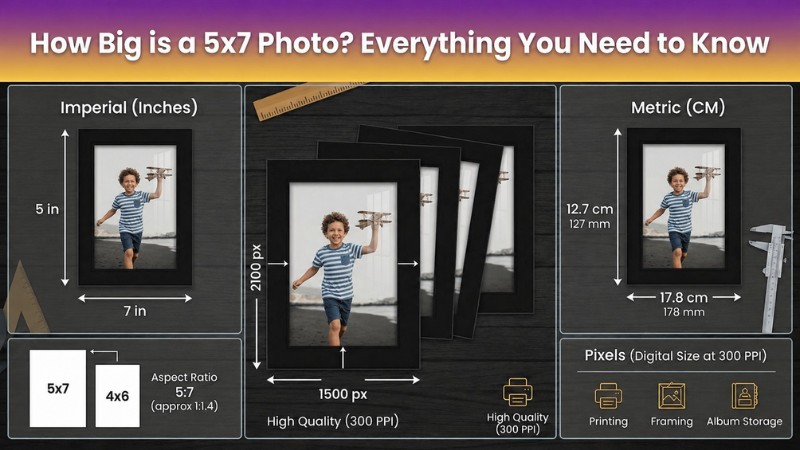
5×7 | Framed photos, portraits | 5:7 | Often requires cropping |
8×10 | Wall displays | 4:5 | Significant cropping is needed before printing |
11×14 | Large prints, artwork | 4:5 | Large-format print compared to 4×6 |
4×6 vs 3x5 Photo Size
Both 3×5 and 4×6 photos use the same 3:2 aspect ratio, meaning there’s no major cropping difference between them. The main distinction is physical size.
A 3×5 photo is:
- smaller
- more compact
- less detailed when viewed closely
Where a 4×6 photo provides:
- better visibility
- sharper perceived detail
- a more balanced viewing experience
Because of its slightly larger dimensions, 4×6 is generally preferred for family photos, albums, and framed prints. Meanwhile, 3×5 prints are often used for budget printing or smaller keepsakes.
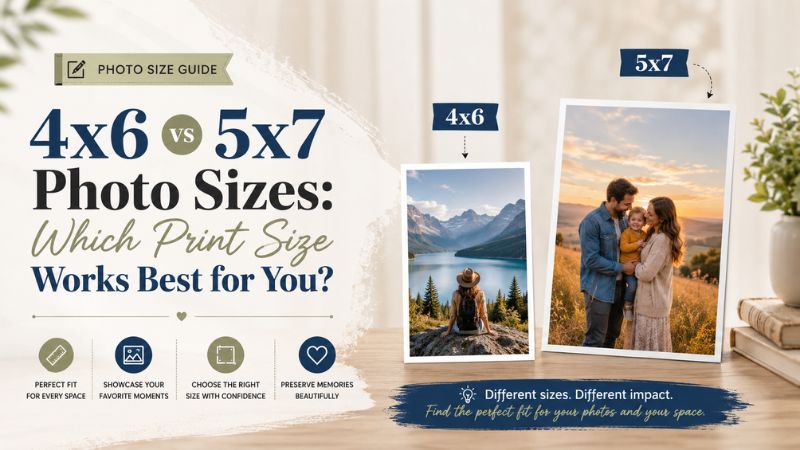
4×6 vs 5×7 Photo Size
The difference between 4×6 and 5×7 photos goes beyond size alone. A 5×7 print uses a different aspect ratio, which means photos often need to be cropped before printing.
A 5×7 photo:
- appears larger and more premium
- works well for portraits and display frames
- requires more wall or desk space
However, because 5×7 does not match the standard 3:2 camera ratio, some parts of the image may get trimmed during printing.
A 4×6 print, on the other hand:
- usually preserves the original image composition
- costs less to print
- fits more easily into albums and storage boxes
If you want everyday prints with minimal cropping, 4×6 is typically the better choice. If you want a more decorative display print, 5×7 may work better.
Learn more about the 5×7 photo size and how it works |
4×6 vs 8x10 Photo Size
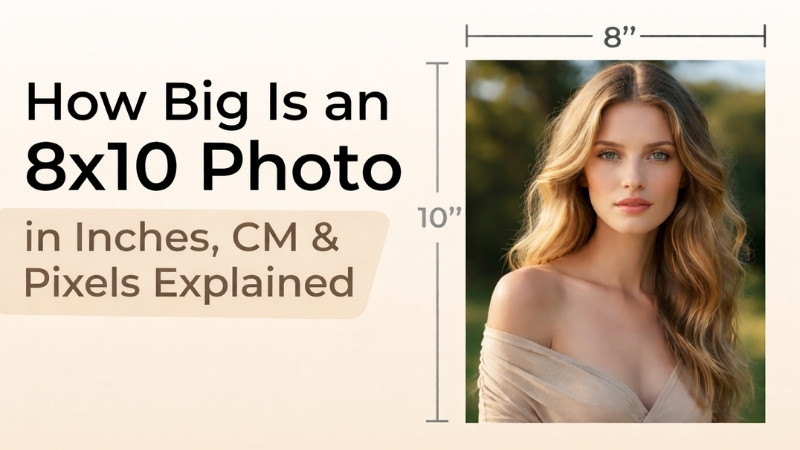
An 8×10 photo is significantly larger than a standard 4×6 print and is commonly used for:
- wall frames
- studio portraits
- professional photography
- home décor
Unlike 4×6, an 8×10 print uses a 4:5 aspect ratio. This means most camera photos will need noticeable cropping to fit correctly.
Compared to 8×10, a 4×6 photo:
- It is easier and cheaper to print
- requires less cropping
- works better for casual and everyday use
Meanwhile, 8×10 prints are better suited for situations where you want the photo to become a visual centerpiece rather than a simple printed memory.
Learn more about the 8×10 photo size and how it works |
4×6 vs 11×14 Photo Size
An 11×14 photo is considered a large-format print and is mainly used for:
- professional photography displays
- gallery-style wall art
- wedding portraits
- decorative framing
Because of its large dimensions, image quality becomes far more important. Low-resolution photos may appear blurry or pixelated when enlarged to 11×14, but they look fine at 4×6.
Compared to 11×14 prints, 4×6 photos are:
- more affordable
- easier to store
- faster to print
- better for albums and everyday handling
While 11×14 creates a stronger visual impact, 4×6 remains the practical choice for regular photo printing and personal use.
How to Resize Images to 4x6: A Step-by-Step Process
To resize a photo properly for a 4×6 print, you need to match the 3:2 aspect ratio, use the correct pixel dimensions, and maintain sufficient resolution for printing. A standard high-quality 4×6 photo size at 300 DPI should be 1200 × 1800 pixels with a 3:2 aspect ratio
Following the steps below helps ensure your 4×6 photos appear and print clearly without unwanted cropping or distortion.
Step 1: Choose an Image With Good Resolution
Before resizing, check the original image quality. A low-resolution image may look fine on a phone screen but become blurry when printed.
For the best 4×6 print quality:
- Use images that are at least 1200 × 1800 pixels
- Choose high-resolution originals whenever possible
- avoid screenshots or heavily compressed images
If your image is too small, enlarging it can reduce sharpness and create visible pixelation.
|
Step 2: Crop the Image to a 3:2 Aspect Ratio
A 4×6 photo uses a 3:2 aspect ratio. If your image uses a different aspect ratio, for example, 4:3 from an iPhone camera, the print may crop unexpectedly.
Cropping the image manually before printing gives you full control over the final composition.
Most editing tools allow you to select a fixed ratio:
- Photoshop: Crop Tool > Ratio > 3:2
- Canva: Edit Photo > Crop > Aspect Ratio > 3:2
- Lightroom: Crop > Aspect > Original > 3×2
- iPhone Photos app: Edit > Crop > Aspect Ratio > 3:2
- Android Gallery Editors: Edit > Crop > Ratio > 3:2
When cropping:
- Keep faces and important subjects away from edges
- center the main focus naturally
- avoid cutting off hands, heads, or background details unintentionally
This step is especially important when printing smartphone photos as 4×6 prints.
Step 3: Resize the Image to 1200 × 1800 Pixels
Once the crop ratio is correct, resize the image to match the ideal 4×6 photo size in pixels.
For high-quality printing:
- Width: 1200 pixels
- Height: 1800 pixels
- Resolution: 300 DPI
These dimensions provide sharp detail and smooth print quality for standard photo prints.
If you’re only using the image digitally or for small prints, lower resolutions may still work. However, 300 DPI produces the clearest and most professional results.
Step 4: Save the Image in the Right File Format
Before uploading or printing your photo:
- Save it as JPEG or PNG
- Use high-quality export settings
- Avoid excessive compression
JPEG is the most commonly accepted format for photo printing because it balances image quality and file size efficiently.
Best Tools to Resize Images for 4×6 Printing
You can find several free and professional tools for resizing photos accurately. Here are some of the best tools for resizing:
| Tool | Best For |
|---|---|
Canva | Quick online resizing |
Photoshop | Professional editing |
Lightroom | Photography workflows |
iPhone Photos App | Simple mobile cropping |
GIMP | Free advanced editing |
Pixlr | Browser-based resizing |
Most of these tools allow you to: crop to 3:2, set custom pixel dimensions, and export at high quality. Using the right tool makes preparing photos for 4×6 printing much easier and helps maintain image quality.
Tips for Printing Perfect 4x6 Photos
A photo that looks sharp on your phone or laptop screen can still print blurry, dark, cropped incorrectly, or pixelated if it isn’t prepared properly. The tips below will help you get the best possible 4×6 photo print quality.
- Use the correct size in pixels: For the best print quality, use images that are at least 1200 × 1800 pixels at 300 DPI. Lower-resolution images may appear blurry or pixelated when printed.
- Crop your image to a 3:2 aspect ratio before printing: A 4×6 photo uses a 3:2 ratio. Cropping the image manually before printing helps prevent unwanted automatic cropping by the photo lab.
- Avoid low-resolution or compressed images: Screenshots, social media downloads, and compressed files often lose detail and sharpness when printed.
- Keep important subjects away from the edges: Borderless printing can trim small portions of a photo’s edges. Leave extra space around faces, text, and important details.
- Check the print preview carefully: Always review the final crop, orientation, and borders before placing a print order to avoid mistakes.
- Choose borderless printing only if needed: Borderless prints look cleaner but may crop the image slightly. Standard prints preserve the full image but can leave white borders.
- Increase brightness slightly before printing: Printed photos often appear darker than they do on screens. Slight brightness adjustments can improve print results.
- Use glossy paper for vibrant colors: Glossy paper enhances sharpness, contrast, and color depth, making it ideal for travel, family, and landscape photos.
- Use matte paper for softer, glare-free prints: Matte paper works well for framed photos, portraits, and professional-looking prints because it reduces reflections and fingerprints.
- Print from the original image: Original camera photos preserve the highest quality and detail compared to edited or repeatedly saved files.
- Use high-quality printing services: Better photo labs provide more accurate colors, sharper prints, and higher-quality paper options.
- Store printed photos properly: Keep 4×6 photos away from sunlight, moisture, and heat to prevent fading over time.
FAQ About 4×6 Photo Size
How big is a 4×6 photo in inches?
A 4×6 photo measures exactly 4 inches by 6 inches. It is the standard photo print size used for everyday photography, family albums, postcards, and picture frames. Depending on orientation, the photo can be printed vertically (portrait) or horizontally (landscape).
What is the pixel size of a 4×6 photo at 300 DPI?
At 300 DPI, which is the standard resolution for high-quality photo printing, a 4×6 photo should measure 1200 × 1800 pixels. This resolution provides sharp detail, accurate colors, and professional-looking print quality without visible pixelation.
Is 4×6 the same as A6?
No, 4×6 and A6 are not the same size. A 4×6 photo measures 4 × 6 inches (10.16 × 15.24 cm), while A6 paper measures 10.5 × 14.8 cm. Although they are similar in size, they use different dimensions and aspect ratios.
What is the standard photo size?
The most common standard photo size is 4×6 inches. It became the industry standard because it matches the 3:2 aspect ratio used by traditional 35mm film and most DSLR cameras, allowing photos to print with minimal cropping.
Is 4×6 portrait or a landscape?
A 4×6 photo can be both portrait and landscape, depending on how you orient it.
- Landscape orientation: 6 inches wide × 4 inches tall (most common for scenery, group photos, travel shots)
- Portrait orientation: 4 inches wide × 6 inches tall (commonly used for portraits, passport-style images, and framed photos)
So, 4×6 is not fixed to a single orientation, the aspect ratio stays the same (3:2), and you simply rotate the image to display it however you want.
How many megapixels do I need for a 4×6 print?
You only need about 2 megapixels for a sharp 4×6 print at standard quality (300 DPI). Most modern phone cameras easily exceed this, so almost any recent smartphone photo will print clearly at 4×6 as long as it isn’t heavily cropped or compressed.
Final Verdict
A 4×6 photo is the standard print size for a reason. Its balanced 3:2 aspect ratio, practical dimensions, and compatibility with most cameras, printers, albums, and frames make it ideal for everyday photo printing.
Whether you’re resizing images, printing iPhone photos, or comparing photo sizes, understanding the exact dimensions, pixel requirements, and aspect ratio of a 4×6 photo helps ensure sharper prints and better overall results.