Skip to main content Scroll Top
  • Home
  • Guide
  • How Big is a 5×7 Photo? Everything You Need to Know

How Big is a 5×7 Photo? Everything You Need to Know

How big is a 5×7 photo? In photography, the details behind that size ensure perfect print quality. This popular size is widely used for portraits, client deliveries, and framed displays.

But it also comes with unique challenges like cropping and resolution adjustments. In this guide, you’ll discover how to optimize your images specifically for 5×7 so they look exactly the way you intended.

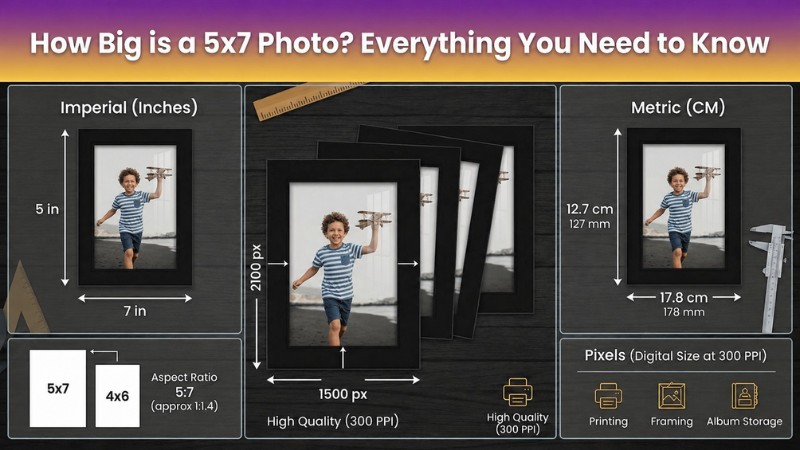
A 5×7 photo is a standard print size that measures 5 inches by 7 inches. It is used in portrait (vertical) or landscape (horizontal) orientation. It’s slightly larger than the common 4×6, giving it a more polished, display-ready look. Sometimes, cropping is needed when printing.

In real-life: 

  • The size of a small notebook or greeting card
  • Big enough to clearly show faces and details
  • Small enough to fit comfortably on a desk, shelf, or side table

It strikes a balance, not too small to ignore, not too large to dominate space.

Why popular?

A 5×7 photo is widely used because it offers:

  • Versatility – works for albums, frames, and gifts
  • Affordability – cheaper than large prints
  • Professional feel – ideal for portraits and events
  • Easy framing – widely available frame sizes

5x7 Photo Dimensions in Inches, CM, MM, and Feet

A 5×7 photo refers to its physical print size, and those same dimensions can be expressed in different measurement units. Understanding each helps you when printing, framing, or working with international labs.

5x7 in inches

Dimensions: 5 inches × 7 inches 

This is the original and most commonly used measurement, especially in the U.S. and the photography industry standards.

  • Width: 5 inches
  • Height: 7 inches

All other unit conversions are based on this.

5x7 in centimeters

Dimensions: 12.7 cm × 17.78 cm 

To convert inches to centimeters, multiply by 2.54:

  • 5 × 2.54 = 12.7 cm
  • 7 × 2.54 = 17.78 cm

This format is widely used in Europe and international print labs.

5x7 in millimeters

Dimensions: 127 mm × 177.8 mm 

Millimeters give more precise measurements:

  • 5 × 25.4 = 127 mm
  • 7 × 25.4 = 177.8 mm

Commonly used in technical printing, design specs, and manufacturing.

5x7 in feet

Dimensions: 0.42 ft × 0.58 ft (approx.) 

To convert inches to feet, divide by 12:

  • 5 ÷ 12 ≈ 0.42 ft
  • 7 ÷ 12 ≈ 0.58 ft

Feet are rarely used for small prints, but can help when planning wall layouts or spacing.

Practical insights:

  • Inches → Best for ordering prints and frames
  • Centimeters (cm) → Useful for international compatibility
  • Millimeters (mm) → Ideal for precision work
  • Feet (ft) → Helpful for visualizing placement on walls


Important: 


Key size variations around the world:

  • In Europe, A5 (148 x 210 mm), which is slightly bigger than 5×7, is commonly used.
  • In Japan, the 2L size is 127 x 178 mm, almost close to the 5×7 inch size.
  • In the UK, a common photo size is 6×8 inches, slightly larger than the 5×7.

How Big is a 5x7 Photo in Pixels?

The pixel dimensions of a 5×7 photo depend entirely on its PPI (pixels per inch), which determines how sharp or detailed the print will appear. The higher the PPI, the more pixels are packed into each inch, resulting in better quality.

5x7 at 72 PPI

Pixel Dimensions: 360 × 504 pixels 

This is considered low resolution, mainly used for:

  • Digital displays (web, email, social media)
  • Quick previews or thumbnails

Prints at 72 PPI will look blurry and pixelated, especially up close.

5x7 at 150 PPI

Pixel Dimensions: 750 × 1050 pixels 

This is a mid-range resolution, suitable for:

  • Casual prints
  • Photo books or scrapbooks
  • Images viewed from a slight distance

Quality is acceptable, but not ultra-sharp.

5x7 at 300 PPI

Pixel Dimensions: 1500 × 2100 pixels 

This is the professional standard for printing:

  • Sharp, crisp detail
  • Ideal for portraits and framed photos
  • Maintains quality even when viewed closely

Most labs and professional printers recommend 300 PPI.

Which resolution should you use?

For professional results, photographers should aim for:

  • Minimum: 150 PPI (only for casual or budget prints)
  • Recommended: 300 PPI (industry standard)

Key reasons:

  • If you’re delivering images to clients, always export at 300 PPI to ensure maximum quality.
  • Modern cameras already capture far more pixels than needed for 5×7, so quality loss usually comes from improper resizing or compression, not camera limitations.
  • Shooting with extra resolution gives flexibility for cropping to the 5:7 aspect ratio.

What Is the Aspect Ratio of a 5x7 Photo?

The aspect ratio of a 5×7 photo is: 5:7. This shows a equal relationship between a photo’s width (5 inches) and height (7 inches). 

That means, 

  • If the photo is 5 inches wide and 7 inches tall (portrait), the ratio = 5:7
  • If it’s 7 inches wide and 5 inches tall (landscape), the ratio = 7:5

However, to calculate this, you should divide width by height 5÷7, which is apx. 0.71. 

Unlike ratios like 4:6 (which simplifies to 2:3), 5:7 cannot be reduced further because 5 and 7 have no common divisor other than 1.

Is 5x7 a Standard Photo Size?

Yes, 5×7 inches (12.7×17.8 cm) is a standard, widely used photo print size. It acts as a versatile, slightly larger alternative to the standard 4×6, offering better detail for display on shelves and mantels. 

Other key reasons are:

  • Widely supported by photo printers and labs
  • Frames and mats are easily available in stores and online
  • Commonly used for portraits, event photos, and gifts
  • Fits neatly into standard frame options like 5×7 or 8×10 with a mat

Where it stands among standard sizes

  • 4×6: Most common for casual prints (camera-native ratio)
  • 5×7: Standard, more refined, and professional-looking
  • 8×10: Standard for larger, display-focused prints

What are the best uses of a 5x7 Photo?

The best uses of a 5×7 photo are as follows:

1. Framed Displays for Home & Office

A 5×7 fits into standard frames, making it ideal for desks, shelves, and bedside tables. It draws attention without overwhelming the space, which is commonly used for family portraits, couple shots, and travel memories.

2. Gifting & Keepsakes

These sizes are more thoughtful than smaller prints. Whether it’s a birthday, anniversary, or graduation, a 5×7 photo works perfectly as a personalized gift, especially when paired with a quality frame.

3. Portrait Photography Prints

Photographers often deliver client images in 5×7 because it offers a professional look without going too large. It’s great for headshots, senior portraits, or lifestyle sessions where detail matters but wall space isn’t required.

4. Event Photography

At events, 5×7 prints are popular for highlighting moments—like couple portraits, family group shots, or posed celebrations. They’re easy for guests to take home or display.

5. Greeting Cards & Invitations

A 5×7 is a standard size for custom cards and invitations. It provides enough space for both imagery and text, making it perfect for weddings, birthdays, and holiday cards.

6. Photo Albums

While 4×6 dominates everyday albums, 5×7 is often used in premium or curated albums to showcase standout images. It helps create a visual hierarchy, making key photos feel more important.

7. Wall Collages & Gallery Layouts

Instead of one large frame, multiple 5×7 prints can be arranged into a gallery wall. This creates a stylish, storytelling effect—perfect for showcasing a series or theme.

Comparing 5×7 to Other Photo Sizes: Detail Overview

Comparing the 5×7 to other popular standard picture sizes helps you choose the ideal photo print size. Before explaining in detail, we’ve highlighted a table below:

5x7 vs 4x6 Photo

The 4×6 is the most common print size because it matches the native aspect ratio of most digital cameras and smartphones. On the contrary, a 5×7 offers a slightly larger, more refined look, often used for framing or gifting. 

The key differences between these two photo sizes are:

Features 5x7 Photo 4x6 Photo
Aspect ratio
5:7 (1.4)
2:3 (1.5)
Cropping needed
Often required
Rarely needed
Print quality
More premium
Standard
Best uses
Framing, portraits, gifts
Photo albums, bulk prints
Display Option
Frames, desk display
Albums, scrapbooks

5x7 vs 8x10 Photo

When comparing how big an 8×10 photo is compared to a 5×7, the answer lies in best uses, aspect ratio, client requirements, and costs. The 8×10 is significantly larger and more suitable for wall display, while the 5×7 remains compact and versatile. 

 The key differences between these two photo sizes are:

Features 5x7 Photo 8x10 Photo
Aspect ratio
5:7 (1.4)
4:5 (1.25)
Visual Impact
Moderate
Strong, eye-catching
Best Uses
Small frames, gifts
Wall art, professional portraits
Display Option
Desk, shelves
Walls, galleries
Cost
Moderate
Higher

5x7 vs 11x14 Photo

The primary differences between a 5×7 and an 11×14 photo are size and usage. For example, 5×7 is a small, versatile portrait size ideal for desktops, shelves, or albums, whereas 11×14 is a large-format print designed for wall display.

The key differences between these two photo sizes are:

Features 5x7 Photo 11x14 Photo
Aspect ratio
5:7 (1.4)
11:14 (1.27)
Visual Impact
Subtle
Bold, gallery-style
Best Uses
Gifts, tabletop frames
Wall decor, exhibitions
Display Option
Small frames
Large wall frames
Cost
Affordable
Expensive

What Frame Size Do You Need for a 5x7 Photo?

A 5×7 photo requires a 5×7-inch frame for a direct, borderless fit. But to make the image more formal or larger, use a mat (border), and the best options are: 

  • 8×10 frame with a 5×7 opening, or 
  • 11×14 frame with a 5×7 opening.

Whatever frame sizes you prefer, take a look at some key considerations: 

  • Using a 5×7 frame, the photo goes straight in and fills the frame. 
  • But for a mat (border around the photo), ensure the mat opening is slightly smaller than 5×7 to prevent the photo from falling.

Pros and Cons of 5x7 Photo Size

The 5×7 photo size is a versatile, popular choice for portraits and gifts, offering more detail and a larger display size than 4×6. Below, we’ve shared the photo size strengths and limitations:

Pros of 5x7 photo size

  • Visually balanced and elegant: The 5:7 ratio gives photos a taller, refined looK ideal for portraits and posed shots.
  • Great detail without being bulky: It’s large enough to showcase details, like facial expressions and textures in portraits. And when printed at 300 DPI provides a clear, sharp image. 
  • Versatile usage: Perfect for frames, albums, greeting cards, invitations, and desk displays, making it a go-to size for many occasions.
  • Professional appearance: Compared to smaller prints like 4×6, a 5×7 often feels more polished, especially for events like birthdays, graduations, school pictures, or studio shoots.
  • Easy framing options: While 4×6 is standard, 5×7 frames are versatile and often come with mats for a more professional look.

Cons of 5x7 photo size

  • Cropping Required: Most DSLRs/mirrorless cameras shoot in 3:2, so printing a 5×7 (5:7 ratio) often requires cropping the image.
  • Storage Limitations: Does not fit into standard 4×6 pocket albums, making it less convenient for large-volume storage.
  • Higher Cost: Costs slightly more per print than standard 4×6, making it less ideal for printing hundreds of vacation photos.

FAQ About 5x7 Photo Size

The aspect ratio of a 5×7 photo is 5:7 for portrait orientation. This proportion ensures the picture remains the same when printed.

The actual size of a 5×7 photo refers to its physical print dimensions: 5 inches×7 inches.

A 5×7 photo in cm measures exactly 12.7 x 17.78 centimeters.

A 5×7 photo in pixels is 1500 × 2100 pixels at 300 PPI, which is the standard resolution for high-quality printing.

The best resolution for printing a high-quality 5×7 photo is 300 DPI.

Final Verdict

Now that you clearly understand how big a 5×7 photo is, you can approach printing with confidence instead of guesswork. From choosing the right resolution to composing your shots with the correct aspect ratio in mind, this knowledge helps you preserve image quality and deliver polished results. 

Whether you’re a photographer or just printing memories, mastering this size ensures your photos always look their best.

Free Trial Call To Action Banner

Related Posts