

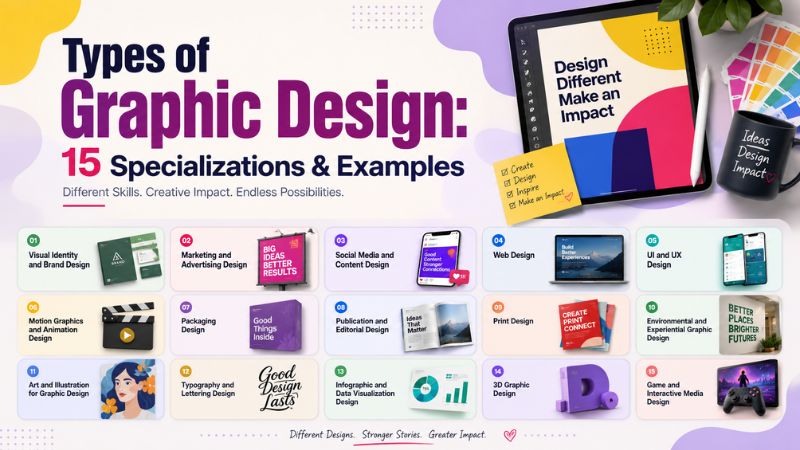

Types of graphic design go far beyond logos and social media posts. Graphic design combines creativity and visual communication to inform, engage, and influence audiences across digital and print platforms.
From billboards and product packaging to websites, apps, and infographics, every design serves a specific purpose. Understanding the different types of graphic design helps businesses, aspiring designers, and individuals choose the right creative solution for their goals.
However, with so many specializations available, knowing where to start isn’t always easy. This guide explores 15 common graphic design types, explaining what each one does, where it’s used, who it’s best for, and how to choose the right specialization. You’ll also learn beginner-friendly fields, common misconceptions, and key career insights.
Table of Contents
ToggleWhat is Graphic Design?
Graphic design is the art and practice of combining visual elements (such as typography, imagery, color, and layout) to communicate ideas, information, or messages effectively. Expert graphic designers blend creativity and strategy to create designs that look great, engage audiences, and help businesses grow.
From brand logos and product packaging to app interfaces, design shapes how people perceive and interact with brands in both print and digital media. In 2026, Business Research Insights reports that approx. 63% of companies rely on graphic design for online marketing campaigns, improving engagement by 34%.
What are the Basic Elements of Graphic Design?
The basic elements of graphic design are as follows:
- Line: A stroke connecting two points; it guides the viewer’s eye, divides sections, creates shapes, and adds structure to a design. It might be straight, curved, thick, thin, dashed, or decorative. Example: dividers on a website, borders, and underlines.
- Shape: A self-contained area (geometric, organic, or abstract) that organizes space and builds icons or symbols. Example: app icons, buttons, and logos.
- Color: Hues, tints, and tones used to set moods, evoke emotions, and strengthen brand recognition. Example: Coca-Cola’s red, Spotify’s green, and IKEA’s blue and yellow.
- Space: Positive space (the subject) and negative/white space (the empty area) that give a design room to breathe. Example: Apple’s minimalist product pages use generous white space to emphasize products.
- Texture: Texture adds depth and visual interest to a design, such as smooth, rough, glossy, or tactile. It can be physical in print or simulated digitally.
- Typography: The style, arrangement, and appearance of text that ensures readability and message delivery to viewers. Example: Headlines, body text, and call-to-action buttons on a website.
- Scale & Size: Size determines the visual importance of an element, while scale refers to the relationship between different elements. Example: A large headline paired with smaller supporting text.
- Image & Illustration: Photos, illustrations, icons, and graphics add personality, tell stories, and create emotional connections. Example: Product photos on eCommerce websites or custom illustrations on SaaS landing pages.
- Form: It gives objects a three-dimensional appearance through shading, perspective, and lighting. Example: 3D product mockups, app icons, and realistic illustrations.
What are the Main Principles of Graphic Design?
The main principles of graphic design are as follows:
- Balance: The distribution of visual weight in a layout. Symmetrical balance uses mirroring elements along a center axis for a calm, formal feel. Asymmetrical balance uses contrasting elements of different sizes or weights to create dynamic, modern layouts.
- Contrast: The purposeful use of differences in color, size, or texture to make specific elements pop and command attention. High contrast is also a critical component of accessible design, ensuring text is readable for all users.
- Hierarchy: Visual hierarchy organizes information based on importance using size, color, spacing, and placement. It helps users scan content and understand the message in the right order.
- Alignment: It ensures that all design elements are visually connected and arranged in an orderly way. Proper alignment creates a clean, professional, and easy-to-read layout.
- Repetition: It reinforces consistency by using the same colors, fonts, icons, or design styles throughout a project. It strengthens brand identity and creates a cohesive visual experience.
- Proximity: It groups related elements together so viewers can easily understand their relationship. It reduces clutter and improves content organization.
- White Space: It is the empty area around design elements. It improves readability, creates breathing room, and helps important content stand out without overwhelming the viewer.
Graphic design principles help transform individual design elements into visually effective compositions.
What are the 15 Main Types of Graphic Design?
The 15 main types of graphic design are described below:
1. Visual Identity and Brand Design
Visual identity and brand design focus on creating a consistent visual image that represents a business, organization, or individual. It combines design elements like logos, colors, typography, and brand guidelines to help people instantly recognize and remember a brand.
Best for startups, small businesses, corporations, and e-commerce companies. Real-world examples are:
- Nike: The iconic Swoosh logo, bold typography, and minimalist design create one of the world’s most recognizable brand identities.
- Coca-Cola: The classic script logo and signature red color have remained recognizable for decades.