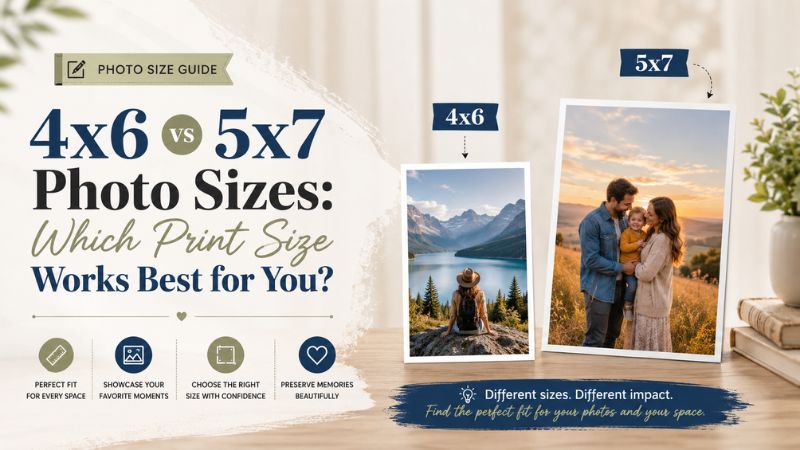

When comparing 4×6 vs 5×7 photo sizes, the main differences center on dimensions, aspect ratio, cropping, framing, and overall visual impact. A 4×6 photo is smaller, cheaper, and ideal for albums and everyday printing, while a 5×7 photo offers a larger, more premium look for frames and displays.
However, because 5×7 uses a different aspect ratio, it often requires more cropping than a standard 4×6 print. This is why choosing the right photo size for the right cause matters more than you think.
To ensure you make the right choice, we have compiled a guide that outlines the exact differences between 4×6 and 5×7, the correct uses, cost differences, and the effects of aspect ratio.
Table of Contents
ToggleUnderstanding Photo Print Sizes
Photo print sizes determine how your digital image appears on paper, including its physical dimensions, aspect ratio, and level of detail. Even a high-quality image can look cropped, stretched, or blurry if the print size doesn’t match its original proportions.
Most standard photo sizes, like 4×6 and 5×7, are designed around common camera aspect ratios, which helps preserve image composition during printing. However, different sizes affect how much of your image is shown, how it fits in frames or albums, and how sharp it appears at different resolutions.
In simple terms, choosing the right photo print size ensures your image looks exactly as you intended, without unwanted cropping or loss of quality.
How Big is a 4×6 photo?
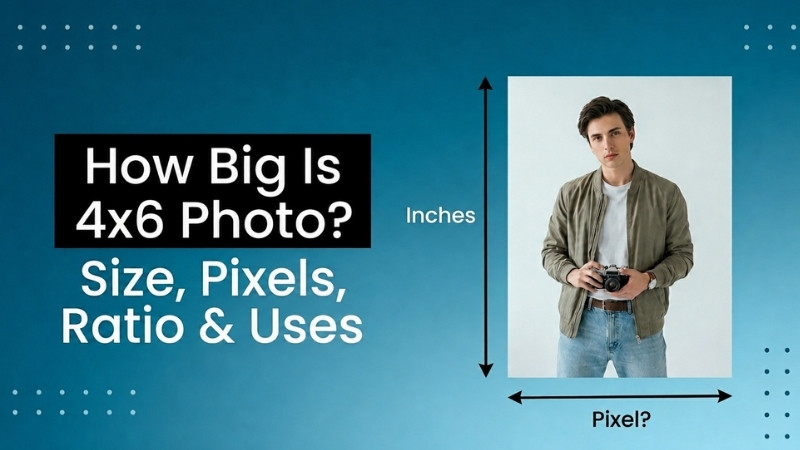
A 4×6 photo is one of the most widely used standard print sizes in photography. It measures 4 inches by 6 inches (10.16 × 15.24 cm) and uses a 3:2 aspect ratio, the same format used by most DSLR cameras and many traditional film cameras.
Because of this natural match with camera output, 4×6 prints usually preserve the original image without heavy cropping. It’s the size most people think of when they picture a “normal photo print”; compact, clear, and easy to store in albums or frames.
In pixel terms, a high-quality 4×6 print at 300 DPI requires: 1200 × 1800 pixels
This makes it suitable for both everyday printing and high-quality photo reproduction. Let’s get to know more about it in detail:
4x6 Photo Dimensions
The exact dimensions of a 4×6 photo are:
- In inches: 4 × 6 inches
- In centimeters: 10.16 × 15.24 cm
- In millimeters: 101.6 × 152.4 mm
- In pixels (300 DPI): 1200 × 1800 pixels
These measurements make it one of the most universally supported photo print formats across printing labs, online services, and home printers.
Because of its balanced proportions, the 4×6 size works well for both portrait and landscape orientation without losing image quality when properly prepared.
Aspect Ratio of 4x6 Photos
The aspect ratio of a 4×6 photo is 3:2, meaning the width is 1.5 times the height.
This ratio is important because it directly affects how your image fits into the print frame. Most DSLR cameras and many professional cameras shoot in 3:2, which is why 4×6 prints often require little to no cropping.
However, smartphones typically use a 4:3 ratio, which means:
- Some cropping is required when printing to 4×6
- Edges may be trimmed during printing if not adjusted manually
Understanding this ratio helps you avoid unexpected cropping and ensures your printed photo matches what you see on screen.
Common Uses of 4x6 Prints
A 4×6 photo is extremely versatile and is used in both personal and professional settings. It remains the default print size for everyday photography because it is affordable, compact, and easy to handle. Common uses include:
- Family photo albums and scrapbooks: it’s the most popular use case due to the perfect storage fit
- Travel photography prints: as it’s easy to collect and organize
- Greeting cards and postcards: widely used for personal messaging
- Event photography: weddings, birthdays, school events
- Tabletop frames: fit standard desk and shelf frames
- Photo gifts and keepsakes: small, meaningful prints for sharing
- ID-style or portfolio prints: compact professional presentation
Because it fits so many everyday needs, 4×6 has become the default “standard photo size” worldwide.
Pros & Cons of Using 4x6 Photo Size
Like any print format, 4×6 has its strengths and limitations depending on how you plan to use your photos.
Pros
- Standard industry size: This photo size is supported by almost all printers and labs
- Affordable printing: It is considered to be the cheapest option for bulk photo printing
- Minimal cropping (for 3:2 images): You get the original picture without cropping, especially from DSLR cameras
- Easy storage: This photo size fits perfectly in albums and photo boxes
- Lightweight and portable: these photos are ideal for sharing and gifting
- Universal compatibility: They work with most frames and print services
Cons
- Smaller visual impact: This is not ideal for wall art or large displays
- Limited detail visibility at distance: The 4×6 size is not suited for large rooms
- Cropping issues with phone photos: You might not get the real image, especially with 4:3 smartphone images
- Less premium feel compared to larger prints: like 5×7 or 8×10
Overall, 4×6 remains the most practical and widely used photo print size, especially for everyday memories and high-volume printing.
How Big is a 5x7 photo?
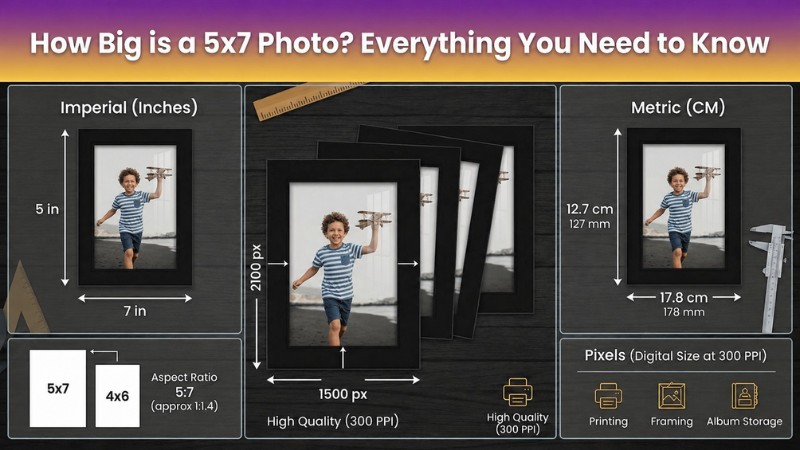
A 5×7 photo is a standard photo print size that measures 5 inches by 7 inches (12.7 × 17.78 cm). It is larger than the standard 4×6 print and is often used for greater visual impact, especially for framed photos, portraits, and display pieces.
In terms of digital resolution, a high-quality 5×7 print at 300 DPI requires: 1500 × 2100 pixels
Because of its larger size, a 5×7 photo shows more detail and feels more “premium” compared to standard everyday prints.
5x7 Photo Dimensions
The exact dimensions of a 5×7 photo are:
- In inches: 5 × 7 inches
- In centimeters: 12.7 × 17.78 cm
- In millimeters: 127 × 177.8 mm
- In pixels (300 DPI): 1500 × 2100 pixels
This size is commonly used in both personal and professional printing because it provides a stronger visual presence than smaller prints, such as 4×6.
Aspect Ratio of 5x7 Photos
The aspect ratio of a 5×7 photo is 5:7, which differs from the 3:2 ratio used in 4×6 prints and by most DSLR cameras.
This difference matters because:
- Most camera photos do not naturally fit 5×7
- Some cropping is usually required when printing
- Composition may shift if important subjects are near the edges
Compared to 4×6 prints, 5×7 photos are more likely to require careful cropping or adjustment before printing to avoid cutting off key parts of the image.
Common Uses of 5x7 Prints
A 5×7 photo is often chosen when people want a more noticeable and display-worthy print. It is commonly used for:
- Framed portraits: ideal for desks, shelves, and wall frames
- Gift photos: birthdays, anniversaries, and special occasions
- Wedding and event photography: highlight key moments
- Professional portrait prints: studio photography sessions
- Decorative displays: home décor and wall arrangements
- Premium photo albums: when a larger, more visible format is preferred
Because of its size, 5×7 prints tend to feel more personal and visually impactful than standard 4×6 photos.
Pros & Cons of Using 5x7 Photo Size
Like any print format, 5×7 has advantages and limitations depending on how you plan to use it.
Pros
- Larger and more visually impactful: It’s better for display and framing
- Great for portraits: This photo size highlights facial details clearly
- Feels more premium: It’s often used for gifts and special occasions
- Better visibility at a distance: It is ideal for desks and wall shelves
- Works well for storytelling photos: It draws more attention than smaller prints
Cons
- More expensive than 4×6 prints: higher printing cost per photo
- More cropping required: especially from smartphone images
- Less storage-friendly: takes more space in albums and boxes
- Not as universally standard as 4×6: fewer default lab settings
- May not match camera aspect ratio: requires careful framing before printing
Overall, a 5×7 photo is best when you want your image to stand out, while 4×6 remains better for everyday, bulk, and album-friendly printing.
4x6 vs 5x7 Photo Size Comparison
When you compare 4×6 and 5×7 photo sizes side by side, the differences may look small on paper, but they actually change how your photos look, feel, and fit into real-life use. The choice really comes down to whether you want something compact and practical or something a bit larger and more display-focused.
Size Difference
4×6 Photo Size
A 4×6 photo measures 4 inches by 6 inches and is considered the standard size for everyday photo printing. Its smaller format makes it compact, easy to store, and ideal for albums, scrapbooks, and casual prints.
5×7 Photo Size
A 5×7 photo measures 5 inches by 7 inches and offers a noticeably larger display area. Even though the size increase seems small, it gives photos more visual presence and makes details easier to notice, especially in frames or tabletop displays.
Aspect Ratio Difference
4×6 Aspect Ratio
A 4×6 photo uses a 3:2 aspect ratio, which matches most DSLR cameras and many traditional photography formats. Because of this, images usually print with very little cropping or adjustment.
5×7 Aspect Ratio
A 5×7 photo uses a 5:7 aspect ratio, which does not naturally match most camera outputs. As a result, photos often need slight cropping before printing to fit the size properly without cutting off important parts of the image.
Print Quality Comparison
4×6 Print Quality
A 4×6 photo keeps images compact and detail-focused, which works well for albums and everyday prints. Since the print size is smaller, photos can still look sharp even with moderate image resolution.
5×7 Print Quality
A 5×7 photo spreads the image over a larger area, which gives it a more display-focused and visually impactful look. With a high-resolution image, it can make portraits and featured photos feel clearer and more premium.
Cost Comparison
4×6 Printing Cost
A 4×6 photo is usually the cheaper option because it uses less paper and ink. It is designed for bulk printing, making it the most budget-friendly choice for albums, events, and large photo collections.
5×7 Printing Cost
A 5×7 photo generally costs more because it is treated as a larger, more premium print size by most photo labs. The higher cost becomes more noticeable when printing multiple photos regularly.
Storage and Album Compatibility
4×6 Storage Compatibility
A 4×6 photo fits perfectly into most standard photo albums, storage boxes, and everyday frames. This makes it very convenient for organizing and storing large collections of printed pictures.
5×7 Storage Compatibility
A 5×7 photo takes up more space and may not fit into standard photo albums unless they are specifically designed for larger prints. However, it works better for standalone frames and display setups where you want the image to stand out more.
When Should You Choose a 4x6 Print?
A 4×6 print works best when you want something practical, familiar, and easy to use in everyday photography. It is the most commonly used photo size because it fits naturally with how most cameras capture images, and it blends smoothly into albums, frames, and general photo storage without extra effort.
Below are the situations where choosing a 4×6 print makes the most sense:
- When you want a standard, no-complication photo size for everyday printing. A 4×6 print is the default size at most photo labs, so you can print quickly without worrying about special settings or adjustments.
- When you are printing photos for albums or scrapbooks. This size fits perfectly into most photo albums, making it ideal for organizing travel memories, family events, school photos, and personal collections.
- When you want to keep printing costs low. Since 4×6 uses less paper and ink compared to larger sizes, it is the most budget-friendly option, especially if you are printing in bulk.
- When your images come from DSLR or mirrorless cameras. Most professional cameras shoot in a 3:2 aspect ratio, which matches 4×6 perfectly and reduces cropping or composition loss.
- When you need multiple copies of photos to share or give as gifts. 4×6 prints are easy to distribute for events like birthdays, weddings, or school functions because they are lightweight and affordable.
- When storage space is limited. Because of its compact size, a 4×6 photo is easier to store in boxes, albums, and folders without taking up much physical space.
- When you want a natural, true-to-camera look without heavy editing or resizing. Since it matches the native aspect ratio of many cameras, your photos usually print the way they were originally shot.
Simply to say, a 4×6 print is the best choice when you want something reliable, cost-effective, and easy to manage, especially for everyday memories rather than large display pieces.
When Should You Choose a 5x7 Print?
A 5×7 print is the better choice when you want your photo to feel more noticeable, more detailed, and more presentation-ready. Compared to a 4×6, it gives your image extra visual space, which makes it ideal when the photo is meant to be seen rather than just stored. It is often used when people want a slightly premium look without moving up to large wall-sized prints.
Here are the situations where a 5×7 print makes the most sense:
- When you want your photo to stand out in a frame or on display. A 5×7 print has a stronger visual presence, which makes it perfect for desk frames, bedside tables, and small wall displays where you want the photo to be noticed easily.
- When you are printing portraits or close-up shots. This size works especially well for portraits because it gives more space to facial details, expressions, and composition, making the subject feel more prominent.
- When you are creating gift photos for special occasions. 5×7 prints feel more thoughtful and premium, which is why they are commonly used for birthdays, anniversaries, weddings, and personal gifting.
- When you want a more “display-quality” version of your image. If the photo is not just for storage but for showcasing, 5×7 provides a better balance between size and clarity.
- When you are building a curated photo collection, instead of bulk printing. Unlike 4×6 prints, which are often used in large quantities, 5×7 photos are usually chosen selectively for highlight moments.
- When you have enough resolution and want to avoid a cramped look. Larger prints, like 5×7, can make images feel less compressed, giving the composition more breathing room when the photo quality is high.
- When you are okay with slight cropping for better presentation. Since 5×7 does not naturally match most camera aspect ratios, it is best used when you are willing to adjust framing for a more polished final result.
In short, a 5×7 print is ideal when you want your photo to feel more expressive, more visible, and more premium, especially for portraits, gifts, and display-focused photography.
4x6 photo vs 5x7 for Framing
When it comes to framing, the difference between 4×6 and 5×7 is not just about size; it directly affects how the photo feels when displayed, how much attention it draws, and how well it fits into standard frame options. Here are the key differences:
4×6 for Framing
A 4×6 photo is the most common framing size, especially for small and everyday display frames. It works well when you want something simple, minimal, and space-friendly.
- It fits easily into standard desk frames and compact wall frames without requiring custom sizing.
- It provides a clean, subtle display that works well for casual photos, memories, and album-style framing.
- It is ideal when you want to frame multiple photos together in a gallery-style layout or collage wall.
- It keeps the focus on convenience, especially when you are printing and framing photos in bulk.
5×7 for Framing
A 5×7 photo is often preferred when the frame itself is meant to be a focal point rather than just a storage display. The slightly larger size noticeably changes the visual impact.
- It creates a stronger visual presence, making it more suitable for standout portraits or special moments.
- It works better for tabletop frames, bedside displays, and feature walls where you want the photo to draw attention.
- It gives more breathing space around the subject, which helps portraits feel more professional and polished.
- It is often used for gift framing, especially for occasions like weddings, birthdays, and anniversaries.
Quick Comparison:
|
Which Photo Size Is Better for Social Media Prints and Gifts?
When choosing between 4×6 and 5×7 for social media prints and gifts, the “better” option depends on how you want the photo to feel when someone receives it or sees it in print. Here’s what to choose:
For Social Media Prints
If you are printing photos directly from Instagram, Facebook, or phone galleries, a 4×6 print is usually the safer and more practical choice.
- Most social media images are already optimized for quick sharing and compact viewing, which fits naturally into a 4×6 size.
- A 4×6 print keeps things simple and avoids over-enlarging images that may not have high enough resolution.
- It is also less likely to show quality issues like pixelation when printed from compressed social media files.
- It works well for printing multiple posts, reels captures, or casual memories in bulk.
However, if the image is high-quality and professionally edited, a 5×7 can also work, but only if the resolution is high enough to handle the larger size.
For Gifts
When it comes to gifting, 5×7 prints usually feel more premium and emotionally impactful.
The larger size makes the photo feel more special and intentional, especially when framed as a gift.
- It works better for portraits, couple photos, and milestone memories where you want the image to stand out.
- A 5×7 print is often used in birthday gifts, anniversaries, weddings, and personalized photo frames.
- It provides more space for visual detail, which enhances the emotional impact when someone receives the photo.
On the other hand, 4×6 can still be meaningful for gifts, especially when you are giving multiple photos together, such as a memory set or a photo album collection.
Simple Way to Decide:
|
Cost Comparison: 4x6 vs 5x7 Prints
When comparing the cost of 4×6 and 5×7 photo prints, the difference is not subtle; it’s consistent, and you can see it all over the marketplace. A 4×6 print is considered the standard for bulk printing, while a 5×7 print is positioned as a larger, more premium enlargement. This difference directly affects pricing across almost all major photo printing services.
4×6 prints (budget, bulk-friendly standard)
Across major retail photo services, 4×6 prints are consistently the lowest-cost option available.
- Walmart lists 4×6 prints at around $0.16 per print for standard pricing tiers (Walmart)
- Walgreens pricing shows 4×6 prints ranging roughly from $0.20 to $0.39, depending on quantity and pickup method (Walgreens)
- CVS pricing typically places 4×6 prints in a similar range of around $0.09 to $0.29, depending on volume and store pricing tiers (CVS)
This means that a 4×6 is designed for high-volume printing at the lowest possible cost, especially for albums, events, and everyday photo collections.
5×7 prints (larger, premium pricing category)
- Walmart prices 5×7 prints at about $1.28 per print in standard tiers (Walmart)
- Walgreens pricing typically places 5×7 prints around $1.49 to $2.99, depending on format and quantity (Walgreens)
- CVS pricing shows 5×7 prints often ranging around $3.99 to $4.99 per print, depending on finish and location (CVS)
Tips for Choosing the Right Photo Print Size
Choosing between 4×6 and 5×7 becomes much easier when you think about how the photo will actually be used, not just how it looks on your screen. The right choice depends on storage, display, cropping, and overall purpose.
- Choose the 4×6 size when printing in bulk or creating photo albums. This size is the most practical for large collections of photos because it is affordable, easy to store, and fits perfectly into standard album layouts without wasting space.
- Choose the 5×7 size when the photo is meant to be displayed or framed. The larger size gives your image more visual presence, making it better for desk frames, wall displays, and any photo you want to highlight.
- Check your image aspect ratio before deciding the print size. If your photo is closer to a 3:2 ratio, it will fit naturally into 4×6 prints, while 5×7 may require more cropping or adjustment.
- Think about how much cropping you are willing to accept. The 4×6 usually preserves more of the original image, while the 5×7 may cut slightly more from the edges, depending on your camera or phone format.
- Consider the purpose of the photo rather than just the size difference. Everyday memories, travel photos, and casual shots work better in 4×6, while portraits, gifts, and special moments often look better in 5×7.
- Factor in your budget when printing multiple photos. The 4×6 prints are significantly cheaper and better suited for large quantities, while 5×7 prints should be reserved for selected images.
- Match the print size with the frame or album you already have. If you already own standard 4×6 frames or albums, sticking with that size avoids unnecessary resizing or compatibility issues.
FAQ
Is 4x6 or 5x7 better for framing?
5×7 is better for framing because it is larger and creates a stronger visual impact, while 4×6 is better for smaller, simple desk or album frames.
Will my phone photos print well at 5x7?
Yes, most smartphone photos print well at 5×7 as long as the image is high resolution and not heavily cropped or compressed.
Do I need to crop my photo for a 5x7 print?
Yes, in most cases, you need to crop your photo for a 5×7 print because its aspect ratio differs from most phone and camera formats.
Which is cheaper, 4x6 or 5x7 prints?
4×6 prints are cheaper because they are designed for bulk printing, while 5×7 prints cost more as they are treated as larger, premium prints.
What is the most popular photo print size?
4×6 is the most popular photo print size because it matches standard camera ratios, fits albums easily, and is widely supported by all photo printing services.
Conclusion
4×6 and 5×7 photo sizes both work well, but they serve different purposes. The 4×6 is the standard everyday print size because it matches most camera formats, is affordable, and fits easily into albums and standard frames. It is best for bulk printing and preserving memories in a simple, practical way.
The 5×7 print is slightly larger and feels more premium, making it better for framed photos, portraits, and gifts where visual impact matters more. It may require a bit more cropping and usually costs more than 4×6, but it offers a stronger display presence.
In the end, 4×6 is the practical standard, while 5×7 is the display-focused upgrade, and the right choice depends on whether you value convenience or presentation.